
Brisk Walking Calorie Calculator — Accurate & Free
Brisk Walking Calorie Calculator
What Is a Brisk Walking Calorie Calculator?
Picture this: you walk 30 minutes every morning before work. You feel better, but you want to know exactly how many calories you are burning. A brisk walking calorie calculator gives you that precise number. It uses your weight, speed, time, and terrain to compute your energy output.
Guessing your calorie burn leads to either overeating or under-fueling. An accurate number helps you plan meals, set fat-loss goals, and track real progress. This guide explains how the calculator works, how to use it, and how to get more from every walk.
What Is Brisk Walking and Why Does It Matter?
Brisk walking means moving at a pace where you breathe harder but can still hold a short conversation. Most experts define it as 4.5–6.5 km/h (2.8–4.0 mph). At this pace, your heart rate rises to 60–70% of its maximum, which is the ideal fat-burning zone.
The CDC recommends at least 150 minutes of moderate activity per week. Brisk walking qualifies as moderate-intensity exercise. It is low-impact, requires no equipment, and suits nearly every age and fitness level.
Regular brisk walking lowers blood pressure, improves insulin sensitivity, and reduces the risk of heart disease. It also burns far more calories than slow strolling — up to 50% more per minute. Knowing your exact calorie burn makes the habit easier to maintain.


The Formula — Explained Simply
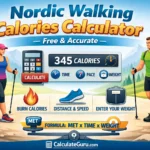
The calculator uses the MET (Metabolic Equivalent of Task) method. This is the gold standard used by exercise scientists and the Compendium of Physical Activities. The formula is straightforward.
Calories = MET × Weight (kg) × Duration (hours)
| Variable | What It Means | Example Value |
|---|---|---|
| MET | Energy cost relative to rest | 4.3 at 5 km/h |
| Weight | Your body mass in kg | 70 kg |
| Duration | Walking time in hours | 0.5 hr (30 min) |
| Terrain factor | Incline multiplier | 1.18 for 5% hill |
| Result | Total calories burned | ~150–300 kcal |
A MET of 1.0 equals the energy you use sitting still. Brisk walking at 5 km/h has a MET of about 4.3, meaning you burn 4.3 times more energy than at rest. Adding an incline raises the MET further because your muscles work harder against gravity.
How to Use This Calculator in 6 Simple Steps
Getting an accurate result takes less than one minute. Follow these steps carefully for the best output.
Step 1 — Enter your body weight. Use a recent scale reading. Choose kilograms or pounds from the dropdown next to the field. More weight means more calories burned per step.
Step 2 — Enter your walking duration. Type the number of minutes you plan to walk or actually walked. Be realistic — most people overestimate their active time by 5–10 minutes.
Step 3 — Select your walking speed. Choose the option that best matches your pace. If you use a fitness tracker, match the speed it reports. Brisk pace (5.0 km/h) is the most common choice for health-focused walkers.
Step 4 — Select terrain and incline. Walking uphill burns significantly more calories. Even a 2% grade raises calorie burn by 8%. Choose the option that matches your usual route. Treadmill users on zero incline should pick Flat.
Step 5 — Enter your age and select your sex. These inputs refine the heart rate zone estimate shown in the results. They do not change the main calorie calculation, which is weight-based.
Step 6 — Tap Calculate Calories. Your results appear instantly below the button. The output shows total calories, distance, steps, fat burned, weekly projection, and your target heart rate zone.
Calorie Burn Reference Table — 30-Minute Brisk Walk
The table below shows expected calorie burn for a 30-minute brisk walk at 5 km/h on flat ground. Values are calculated using the MET method and rounded to the nearest calorie.
| Body Weight | Calories (30 min) | Calories (60 min) | Steps (approx.) |
|---|---|---|---|
| 50 kg / 110 lb | 108 kcal | 215 kcal | ~3,300 |
| 60 kg / 132 lb | 129 kcal | 258 kcal | ~3,300 |
| 70 kg / 154 lb | 151 kcal | 301 kcal | ~3,300 |
| 80 kg / 176 lb | 172 kcal | 344 kcal | ~3,300 |
| 90 kg / 198 lb | 194 kcal | 387 kcal | ~3,300 |
| 100 kg / 220 lb | 215 kcal | 430 kcal | ~3,300 |
| 120 kg / 265 lb | 258 kcal | 516 kcal | ~3,300 |
Real-World Examples
These two scenarios show all the calculator outputs so you can see what to expect from a real session.
5 Proven Ways to Burn More Calories While Walking
Small changes to your walking routine can meaningfully increase calorie burn without adding more time.
1. Add incline. Walking up a 5% grade burns about 18% more calories than flat walking at the same speed. Find a hilly route or increase your treadmill incline by 3–5%. This is the single most effective change you can make.
2. Increase your speed gradually. Moving from 4.5 km/h to 6.0 km/h raises your MET from roughly 3.8 to 5.0. That is a 30% increase in calories per minute. Build speed over 2–3 weeks to protect your joints.
3. Use interval bursts. Alternate 2 minutes of fast walking with 2 minutes at your normal pace. This technique raises your average MET and continues burning calories after the walk ends through an effect called EPOC (excess post-exercise oxygen consumption).
4. Carry light hand weights or a weighted vest. Adding 5–10% of body weight as load increases calorie burn by roughly 5–8%. Keep weights light enough that your gait stays natural and injury-free.
5. Walk after meals. A 15-minute walk after eating improves blood sugar control and adds meaningful calorie burn across the day. Three post-meal walks equal one dedicated 45-minute session in terms of total energy used.
What Most Walking Guides Miss
Most calorie guides only show flat-ground estimates. They ignore how much terrain changes the math. A 10% incline nearly doubles your calorie burn compared to flat walking at the same speed. That difference matters if you walk in a hilly city or use a treadmill with any incline set.
Guides also rarely mention body composition. A 70 kg person with higher muscle mass burns slightly more calories at rest and during exercise than someone of the same weight with less muscle. The MET formula uses total body weight, so it does not capture this nuance. Your real burn may be 5–10% higher if you have an active lifestyle and lean physique.
Finally, very few guides explain that calories burned walking does not equal net calories burned. You would have burned some calories at rest during that same time period. The true net calorie expenditure from walking is total calories minus resting metabolic rate during the session. For a 30-minute walk, this difference is roughly 20–30 kcal — small but worth knowing for precise tracking.
Frequently Asked Questions
How many calories does 10,000 steps burn brisk walking?
For most adults, 10,000 steps at a brisk pace covers about 7–8 km and burns 300–500 kcal depending on body weight. A 70 kg person burns roughly 380–420 kcal completing 10,000 steps at 5 km/h. Heavier individuals burn more; lighter individuals burn less per step.
Is brisk walking better than running for fat loss?
Running burns more calories per minute than walking. However, brisk walking is lower impact and easier to sustain for longer durations. Over a 60-minute session, some studies show the total calorie difference between brisk walking and easy jogging to be 20–30%. For people with joint issues or those starting a fitness routine, walking is often the smarter long-term choice.
How accurate is the MET calorie formula?
The MET formula is accurate within 10–15% for most healthy adults. Lab studies using oxygen consumption as the true measure show MET-based estimates are reliable for population-level guidelines. Individual variation in fitness level, gait efficiency, and walking surface can cause deviation. Using actual bodyweight and correct speed makes the estimate as precise as possible without lab equipment.
Does walking speed affect fat burn or just total calories?
At lower intensities, your body uses a higher proportion of fat as fuel. At faster brisk speeds (above 6 km/h), you start using more carbohydrates. However, total fat grams burned in absolute terms is still higher at faster speeds because total calories burned is greater. For pure fat loss, both moderate and higher walking speeds work well — what matters most is total calorie deficit across the day.
How many calories should I aim to burn walking per day?
The CDC recommends burning at least 150–300 calories through moderate exercise daily. For walking, this translates to 30–60 minutes of brisk pace for a 70 kg person. If your goal is weight loss, burning an additional 300–500 kcal per day through walking — combined with a modest diet adjustment — creates a sustainable 0.5 kg per week deficit without extreme restriction.






Tushar is the founder of CalculateGuru, a platform dedicated to creating simple, accurate, and user-friendly online calculators. He focuses on building helpful tools across finance, health, math, cooking, and lifestyle to make everyday calculations faster and easier for everyone.